Education and Professional Practice:
1983-1986 - Graduated Theater Directing Studies at Kibbutzim College of Education, Tel Aviv
Professional experience - Appointments and Positions:
Artistic direction:
1989-1993 - Resident director in "Habima" Israel National Theater.
1996-2001 - Artistic Director of the “Khan” theater of Jerusalem.
2001-2004 - Artistic Director of the "Israel Festival" in the fields of theater, dance and Israeli creation.
2004-2006 - Artistic Director of the "Lab" theater, Jerusalem.
2007-2011 - Artistic director of the "Herzliya Ensemble" theater.
Teaching:
1987-1989 - Kibbutzim College of Education, Tel Aviv
1989 - "Gitis" Theater Academy , Moscow
2001-2004 - School of Visual Theater, Jerusalem
Since October 2011- Teaching in the Theater Department, Faculty of Art, Tel Aviv University, Associate Professor. In 2015 she founded the Directing Department.
Experience - Professional activities and projects in Israel and abroad:
Theater Director (selection):
1987-1990 - Beit Zvi, the School of the Arts:
The House of Bernarda Alba, The Merchant of Venice, Bent (performed at the International Festival in Leningrad), Equus (performed in Moscow International theater Festival).
1989 - Young Opera Moscow: The Prodigal Son.
1989-1993 - Habima theater: Gold, The Night of the Twenties, The Glass Menagerie, Punktchen und Anton, Hypolitus, Creditors, Low Depth.
2002 - The Screens (in cooperation with the Berlin Festival), Alice in Wonderland.
1994-1995 - Be'er Sheva municipal Theater:
Summer and Smoke, Educating Rita.
1996-2001 - Khan Theater:
The Wedding, Scenes From an Execution (performed in Brussels Kunst International Festival), Princess Yvonne, The Virgin from Ludmir, Sky, The Seagull , Back to Desert.
2006 - The Town of the Little People (performed in Lodz International Festival)
2005 - Lab Theater: Salomé
2006 - Theatronetto: In Spitting Distance ( A play which won the first prize at the festival Theatronetto and has been performed in the theater of Peter Brook in Paris , The Barbican center in London, Romaeurope Festival, the Sydney Opera, Theater Schaubuhne Berlin and others. )
The play was nominated among the five final candidates for the prestigious international prize: Freedom to Create.
Haifa Theater:
2010 - Ulysses on Bottles
2013 - Sea Breeze
2007-2011 - Herzliya Ensemble Theater:
Black Rain (in cooperation with Haifa Theater , has been performed in the international festival in New York ), Yerma ( performed in the International Festival in Budapest ; the show was created in cooperation with the actress Gili Ben Ouzilou and dedicated as a memory to her).
Don Quixote's Claim , The Town of the Little People ( a remake with the ensemble’s actors , the play was performed in the Municipal Theatre in Heidelberg , Germany, and at the Barbican, London ).
Three Sisters, Both Upon a Time (in cooperation with the Israeli culture festival in Basel, Theaterspektakel ,Zurich Festival, Tak theater Liechtenstein and the Haifa Theater.)
Six Characters in Search of an Author (Cooperation with acting students, Tel Aviv University)
International independent projects:
2012 - Yes, stand out of my Sun (in cooperation with Tak Theater in Lichtenstein, Theatersektakel, Zurich Festival, Spielart Festival Munich, and the Kur theater in Baden.)
2013 - Jungle of the City (Municipal Theater Augsburg , Germany). The play was performed with the ensemble’s actors, in the German language. Rehearsals included collaboration between directing students in theater department - Tel Aviv University and students of the Theater Directing School, Munich.
2015 - Three Dog Night (in cooperation with Deutches Theater-Berlin, Hellerau-Dresden)
2016 - Nathan Der Weise (produced by Goethe Institut, Tel Aviv)
2016 - The Bees Road (an independent project)
2018 - KIND OF (an independent project)
2021 - The Queen Commanded Him to Forget (Produced by Pierre Boulez hall, Berlin)
Membership in committees and artistic judgment:
1995 - Member of the committee - Fringe center in Tel Aviv - Jaffa
1998 - Member of the artistic Prize committee of the Acco Festival
1999 - Member of the festival's Prize committee of Theatronetto
2000 - Member of the artistic committee of the theater festival in Zurich Theaterspektakel - Zurich
Since January 2013 a member of a committee of scholarships for young artists from the cathedra for Human Rights named after Emile Zola - Faculty of Law, Rishon Lezion.
2016 - Member of the artistic Prize committee of the Acco Festival
2021 - Member of the artistic prize committee of Dance festival 1/2/3 Suzanne Dellal center
Awards:
1991 - Wins a scholarship for directing opera on a behalf of the American- Israel Cultural Foundation
1999 - Winner of the Best Director Award of the Israel Theater Prize for directing the classic play : The seagull (by Anton Chekhov). Khan Theater.
2000 - Winner of the Best Director Award of the Israel Theater Prize for the best show of the year: The return to the desert (by Bernard- Marie Koltez). Khan Theater.
2007 - Winner of Landau award for Arts a behalf of the National Lottery, for the achievements and excellence in theater creation.
2010 - Winner of Rosenblum award on behalf of Tel Aviv municipality for the entirety of her creation.
2011 - Winner of the best show (of the original Israeli play ) on the behalf of the Israeli Theater Award for “Youlisses on Bottles”. Haifa Theater.
Henig teaches in Tel-Aviv, creates in Berlin and lives with her partner - the poet Shimon Bouzaglo, in Daliyat al-Karmel.
|
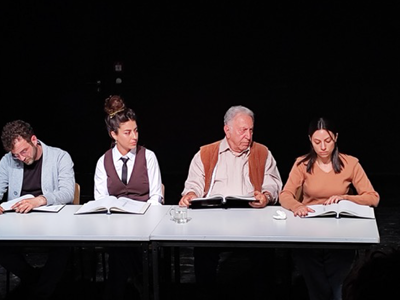
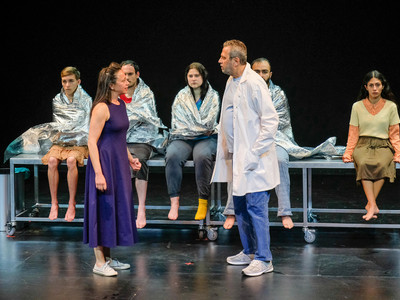
Gaza: Eyewitnesses
Yesterday`s Encounter
Terribly Human
|
the night of resistance
Premiere: 3/3/2026, Berlin
THE INNOCENTS is a transnational and interdisciplinary music theatre project by Ofira Henig in collaboration with Khalifa Natour, and an international ensemble of artists.
Taking The Pied Piper of Hamelin as its point of departure, the project raises a question: What was the music that the Piper played to the children, making them follow him into the
unknown?
A question we may never be able to answer, yet it certainly enables a journey into a personal multicultural musical world and opens a discussion about the role of music in our world.
At the heart of the project are the participants; personal memories of childhood stories and lullabies. The artists, all now living and working in Berlin, bring with them experiences shaped by migration, conflict, war, and social rupture. Yet, amidst the love for music and theater, the magic and humor reveal themselves, proving that, at least on stage, they win
the wars.
Inspired by the well-known legend and its current and inspiring versions and interpretations, they develop a shared theatrical language while exploring the impact of music as an abstract art form - in contrast to words and concrete language - on human beings and their world. The result is a space of encounter that reflects the violence and hubris of history and the present while asking for a possible utopia: hope as activism, the resistance of the innocents.
Music: Francisco Lucena Pais
Visual concept: Korbinian Schuetze
Acting: Khalifa Natour, Felix Goeser, Jala Al Baroudi, Hannah Drill
Musicians: Francisco Lucena Pais, Mahsa Khatibzadeh, Paula Mejiav, Huma Beyza Unal, Manuel Daviv Dias
* Limited Run
Future Projects
2027
THE INNOCENTS
the night of resistance
|
 sko-studio